Q1. The midpoint of the segment between 3 and 10 is
- 1) 6.5
-
2)

- 3) Both A and C
- 4) 6
Solution
The
midpoint of a and b is
 .
.
.
Q2. Between the rational numbers  and
and  there is/are ______ rational numbers.
and there is/are ______ rational numbers.Solution
Between the rational numbers and there are no rational numbers.
Since, in its simplified form is .
and there are no rational numbers.
Since, in its simplified form is .
Q3. Every
terminating number can be represented as a ……….number.
Solution
Every
number can be represented as a rational number.
Q4. Solve the following expression using properties of rational numbers: 
Solution
 (by commutativity)
 (by distributivity)
Q5. The mean of 6 and 0.6 is
Solution
Mean = (6+0.6) ÷ 2=3.3
Q6. Use the number line to work out  .
.
.Solution
 Here, dividend is -8 and divisor is 4.
So, the single jump of -8 can be split into 4 equal jumps of -2.
Thus, = -2
Here, dividend is -8 and divisor is 4.
So, the single jump of -8 can be split into 4 equal jumps of -2.
Thus, = -2
Q7. The midpoint of the segment between -5
and -7 is
- 1) Both B and C
-
2)

- 3) 6
- 4) -6
Solution
The
midpoint of a and b is 
Q8. 0.0001 <...... <0.01
Solution
The numbers should be more than 0.0001 and less than 0.01.
Q9. The sum of a, b, c and d in the following figure is
-
1)

- 2) 24
-
3)

- 4) 23
Solution
Since each unit is divided into 5 equal parts, we have

Q10. 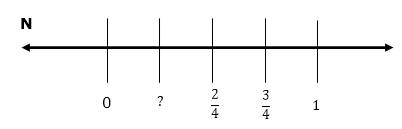
-
1)

- 2) 4
-
3)

-
4)

Solution
The
numbers should be more than 0 and less than .
.
.
Q11. Reciprocal of any natural number lies between
Solution
A natural number is always equal to or greater than 1.
The reciprocal of a number which is greater than 1 is always less than 1.
Moreover, all natural numbers are positive and reciprocal of a positive number is always positive.
Therefore, the reciprocal of any natural number lies between 0 and 1.
Q12. In
the rational number  , such that q≠0, p and q are ………………
, such that q≠0, p and q are ……………… Solution
p and q can be any
integers, such that q≠0.
Q13. Which
of the following is a rational number?
Solution
A
rational number is one which can be expressed as  , where b≠0.
, where b≠0.
Q14. Which is the bigger set?
Solution
Rational
numbers include integers, natural numbers and whole numbers.
Q15. If a is an integer and b is a rational number, then the number of rational numbers between a and b is
Solution
All integers are rational numbers with denominator 1.
We know that between any two rational numbers, there are infinite rational numbers.
Thus, there are infinite rational numbers between a and b.
Q16. Verify that −(−x) = x for 
Solution
The additive inverse
of  is
is  Because,
  The equality shows
that the additive inverse of is
The equality shows
that the additive inverse of is  Or
Or  =
Or -(-x) = x
Hence Verified.
=
Or -(-x) = x
Hence Verified.
is
Because,
The equality shows
that the additive inverse of is
Or =
Or -(-x) = x
Hence Verified.
Q17. Rational
numbers between  are
are
are-
1)

-
2)

-
3)

- 4) All of the above
Solution
The
numbers should be more than  and less than
  .
.
and less than .
Q18. Insert a rational number between (x - y)-1 and x-1 - y-1, where  and
and 
and Solution
Given that  Therefore,
 Rational number between
 Which is the required number
Therefore,
Rational number between
Which is the required number
Q19. The product of a non-zero rational number and its additive inverse always lie
Solution
A non-zero rational number and its additive inverse have opposite signs.
Therefore, on multiplying them, the product will always have a negative sign, since product of a positive and a negative
number is negative.
Also, we know that all negative rational numbers lie on the left side of 0.
Thus, the product of a non-zero rational number and its additive inverse always lie on the left of 0.
Q20. Rational numbers between 11 and 14 are
Solution
The
numbers should be more than 11 and less than 14.
Q21. Find the 29 rational numbers between
Solution
 And
And  Now the 29 integers between -20 and 10 are -19, -18, -17, . . . . . . . 8, 9 .
The corresponding 29 rational numbers between are
Now the 29 integers between -20 and 10 are -19, -18, -17, . . . . . . . 8, 9 .
The corresponding 29 rational numbers between are

Q22. Use the number line to work out 
Solution
 On the number line
  means three jumps of 4 to left of 0.
By making three jumps of 4 we move 12 spaces to left of 0 and reach at the point -12.
Thus,
means three jumps of 4 to left of 0.
By making three jumps of 4 we move 12 spaces to left of 0 and reach at the point -12.
Thus,  .
.
Q23. Represent  on the number line.
on the number line.Solution
The number lie between 0 and 1.
Draw a number line. Mark points O and A to represent 0 and 1 repectively. Divide OA into 5 equal parts (equal to the denominator of ).
The second point, Q, represents the rational number .

lie between 0 and 1.
Draw a number line. Mark points O and A to represent 0 and 1 repectively. Divide OA into 5 equal parts (equal to the denominator of ).
The second point, Q, represents the rational number .
Q24. Represent the rational number 0.5 on the number line.
Solution


Comments
Post a Comment