Q1. Surface area of a cube is 486 cm2. Find the length of its side.
Solution
6 x side2 = 486 side2 = 81 side = 9 cm
Q2. A rectangular tank is 3 m long, 2.5 m wide and 1.4 m deep. Calculate its capacity in liters.
Solution
Here, L = 3 m, B = 2.5 m and H = 1.4 m
Volume of tank = L x B x H = 3 x 2.5 x 1.4 = 10.5 m3
Now, 1 m3 = 1000 liters
Therefore, Capacity of tank = 10.5 x 1000 = 10500 liters.
Q3. A cuboidal box with sides 21 cm x 20 cm x 18 cm is to be filled with cuboidal boxes with sides 7 cm x 6 cm x 5 cm. How many cuboids can be placed in it?
Solution
number of cuboids = 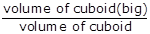 =
=  = 36
= 36
=
= 36
Q4. Find the area of the quadrilateral.
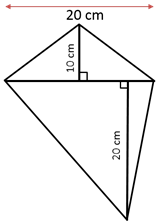
Solution
Area of a triangle = ½ × base × heightArea of a quadrilateral = 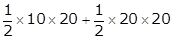 = 100 + 200= 300 cm2
= 100 + 200= 300 cm2
Q5. In the figure given below, a circle is inscribed inside another circle. The radius of the outer circle is 12 cm and that of the inner circle is 7 cm. Find the area of the shaded portion between the circles.

Solution
Given,
Radius of the outer circle = 12 cm
So, area of the outer circle =  r2
= 3.14 x 122
= 452.16 cm2
Radius of the inner circle = 7 cm
Area of the inner circle = r2
=
r2
= 3.14 x 122
= 452.16 cm2
Radius of the inner circle = 7 cm
Area of the inner circle = r2
=  x 72 = 154 cm2
Thus, the required area of the shaded portion
= Area of the outer circle - Area of the inner circle
= 452.16 - 154
= 298.16 cm2
x 72 = 154 cm2
Thus, the required area of the shaded portion
= Area of the outer circle - Area of the inner circle
= 452.16 - 154
= 298.16 cm2
r2
= 3.14 x 122
= 452.16 cm2
Radius of the inner circle = 7 cm
Area of the inner circle = r2
= x 72 = 154 cm2
Thus, the required area of the shaded portion
= Area of the outer circle - Area of the inner circle
= 452.16 - 154
= 298.16 cm2
Q6. In the given figure, ABCD is a trapezium in which parallel sides AB and DC are of length 24 m and 10 m. Also, CE||AD. If area of triangle CEB is 84 m2. Find the area of given trapezium.
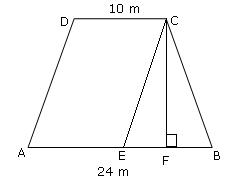
Solution
Now AECD is a parallelogram, therefore AE = DC = 10 m
Therefore, EB = 24 - 10 = 14 m
Now, area of triangle CEB = 84 m2


Q7. The volume of a cylinder is 1408 cm3 and its height is 7 cm. Find its total surface area.
Solution
Here, h = 7 cm
Let r be the radius of cylinder.
Now, Volume = 1408 cm3
 Therefore,

Therefore,
Q8. Raju wants to fence the garden in his house which is in the shape of a rectangle having dimensions 25 m x 18 m. Find the cost of fencing at the rate of Rs 200 per metre.
Solution
The length of the fence required is the perimeter of the rectangular garden. Given that: Length (l) = 25 m ; Breadth (b) = 18 m i.e., Perimeter = 2 x (l + b) = 2 x (25 + 18) = 2 x 43 = 86 m So, the perimeter of the garden or the length of the fence required is 86 m. Cost of fencing 1 m = Rs 200 Thus, Cost of fencing 86 m = Rs 200 x 86 = Rs 17,200
Q9. A rectangular park is 38 m long and 15 m wide. A path 3.5 m wide is constructed outside the park. Find the perimeter of the path.
Solution
The above data can be shown in a figure as follows: 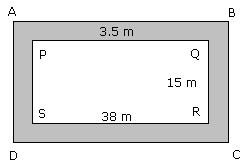 Let PQRS represent the rectangular park and the shaded region represent the path 3.5 m wide. Thus, to find the length AB and breadth BC, we have to add 3.5 m to both sides of rectangular park whose dimensions are 38 x 15 So, the length and breadth of the path are: Length AB = (38 + 3.5 + 3.5) m = 45 m Breadth BC = (15 + 3.5 + 3.5) m = 22 m So, perimeter of the path = 2 x (l + b) = 2 x (45 + 22) = 2 x 67 = 134 m Thus, perimeter of the path is 134 m.
Let PQRS represent the rectangular park and the shaded region represent the path 3.5 m wide. Thus, to find the length AB and breadth BC, we have to add 3.5 m to both sides of rectangular park whose dimensions are 38 x 15 So, the length and breadth of the path are: Length AB = (38 + 3.5 + 3.5) m = 45 m Breadth BC = (15 + 3.5 + 3.5) m = 22 m So, perimeter of the path = 2 x (l + b) = 2 x (45 + 22) = 2 x 67 = 134 m Thus, perimeter of the path is 134 m.
Q10. An iron pipe is 56 cm long with its outer diameter 5 cm and inner diameter 4 cm. If the metal weighs 12 grams per cubic cm, what is the weight of pipe?
Solution
Here, Height of pipe (h) = 56 cm
Inner radius (r) =4/2 = 2 cm
Outer radius (R) = 5/2 cm
 Now, weight of pipe = 396 x 12 grams = 4752 grams.
Now, weight of pipe = 396 x 12 grams = 4752 grams.
Q11. How many 5 cm cubes can be obtained from a cube of side 30 cm.
Solution
Volume of cube of side 5 cm = (Side)3 =53 = 125 cm3
Also, the volume of cube of side 30 cm = (Side)3
=303 = 27000 cm3
Number of cubes of side 5 cm =  Hence, 216 cubes are obtained.
Hence, 216 cubes are obtained.
Q12. A wire is in the shape of a square of side 22 cm. If the wire is re-bent into a circle, find its radius. Also find the area of circle.
Solution
Given that the side of the square = 22 cm
Length of the wire = perimeter of the square
= 4 x side = 4 x 22 = 88 cm
Since the same wire is used to make the circle, both will have the same perimeter.
So, perimeter of the circle = 88
 Thus, radius of circle = 14 cm
Now, area of circle =
Thus, radius of circle = 14 cm
Now, area of circle = 
Thus, radius of circle = 14 cm
Now, area of circle =
Q13. A solid iron pole consists of a cylinder of height 220 cm and base diameter 24 cm, which is surmounted by another cylinder of height 60 cm and radius 8 cm. Find the mass of the pole, given that 1 cm3 of iron has approximately 8g mass. (Use  = 3.14)
= 3.14) Solution
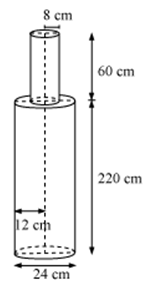 From the figure we have
Height (h1) of larger cylinder = 220cm
Radius (r1) of larger cylinder =
From the figure we have
Height (h1) of larger cylinder = 220cm
Radius (r1) of larger cylinder =  = 12cm
Height (h2) of smaller cylinder = 60cm
Radius (r2) of smaller cylinder = 8cm
= 12cm
Height (h2) of smaller cylinder = 60cm
Radius (r2) of smaller cylinder = 8cm
 Mass of 1 cm3 iron = 8 gm
Mass of 111532.8 cm3 iron = 111532.8 x 8
= 892262.4 gm = 892.262 kg
Mass of 1 cm3 iron = 8 gm
Mass of 111532.8 cm3 iron = 111532.8 x 8
= 892262.4 gm = 892.262 kg
Q14. A closed cylindrical tank of radius 7 cm and height 5 cm is made from a metal sheet. If the breadth of the rectangular sheet is 10 cm, then find the length of the sheet.
Solution
Here, Radius (r) = 7 cm and height (h) = 5 cm
Total surface area of cylindrical tank = 
 Let the length of sheet required be x cm.
Now, Area of sheet = Area of cylindrical tank
Let the length of sheet required be x cm.
Now, Area of sheet = Area of cylindrical tank
 Hence the length of sheet is 52.8 cm.
Let the length of sheet required be x cm.
Now, Area of sheet = Area of cylindrical tank
Hence the length of sheet is 52.8 cm.
Q15. The surface area of a cuboidal wooden box is 470 cm2. If its length and breadth is 15 cm and 8 cm respectively. Find its height.
Solution
Here, l = 15 cm and b = 8 cm
Let the height of box be h cm.
Now, Surface area of box = 2(lb + bh + hl)
But surface area is given 470 cm2.
Therefore, we have

Q16. Find the surface area of the four walls of a cubical room whose side is 4m. Find the cost of whitewashing the room at the rate of Rs 5 per square metre.
Solution
Side of cube = 4 m
Area of 4 walls = 4(Side)2 = 4(4)2 = 4 x 16 = 64 m2.
The whitewashing is done on 4 walls and 1 roof,
So the surface area of 4 walls and 1 roof
= 5(Side)2 = 5(4)2 = 5 x 16 = 80 m2
Cost of whitewashing = Rs 5 x 80 = Rs 400.
Q17. How many silver coins, 1.75 cm in diameter and of thickness 2 mm, must be melted to form a cuboids of dimensions ?
?
? Solution
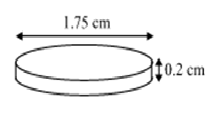 Coins are cylindrical in shape.
Height (h1) of cylindrical coins = 2 mm = 0.2 cm
Radius (r) of circular end of coins =
Coins are cylindrical in shape.
Height (h1) of cylindrical coins = 2 mm = 0.2 cm
Radius (r) of circular end of coins =  Let n coins were melted to form the required cuboids.
Volume of n coins = Volume of cuboids
Let n coins were melted to form the required cuboids.
Volume of n coins = Volume of cuboids
 Hence, number of coins melted to form such cuboids is 400.
Q18. Find the area of the following quadrilateral ABCD, where the length of diagonal AC = 8 cm and the length of perpendiculars DP and BQ are 4.5 cm and 3.5 cm respectively.

Solution
Here, Diagonal AC = 8 cm
Perpendicular DP = 4.5 cm
And, Perpendicular BQ = 3.5 cm
Therefore, sum of perpendicular = DP + BQ = 4.5 + 3.5 = 8 cm
Now, Area of quadrilateral = 

Comments
Post a Comment