Q1. The measure of interior angle of a regular polygon is five times the measure of its exterior angle. Find the number of sides in the polygon.
Solution
From the given condition, we have:

Q2. If two adjacent angles of a parallelogram are equal, then it is a
Solution
In a rectangle as well as in square, each angle is 90o, so their adjacent angles are supplementary as well as equal.
Q3. For the quadrilateral PQRS, which of the following option is incorrect?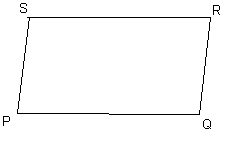
-
1)

-
2)

-
3)

-
4)

Solution

Q4. The measure of two angles of a quadrilateral are 115o and 45o , and the other two angles are equal. Find the measure of each of the equal angles.
Solution
Let the measure of the each equal angle be xo
∴ 115 + 45 + x + x = 360
(As the sum of angles of quadrilateral is 360o)
⇒ 160 + 2x = 360
⇒ 2x = 360 - 160
⇒ x = 100
Hence, the measure of each of the equal angles is 100o .
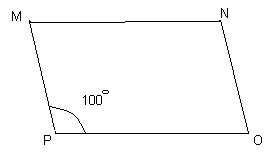
Q5. For the given parallelogram MNOP, which of the following option is incorrect?
-
1)

-
2)

-
3)

-
4)

Solution

Q6. For a rhombus, which of the following statement is correct?
Solution
A rhombus has all the properties of a parallelogram.
Hence, opposite sides and opposite angles are equal in a rhombus.
Also diagonals bisect each other but they are not equal.
Q7. 
Solution


Q8. The sum of the angles in a quadrilateral is always
Solution
The sum of the angles in a quadrilateral is 360o.
Q9. A regular polygon with each exterior angle of 18o has number of sides equal to
Solution
We know that sum of all exterior angles of a polygon is 360o.
Since, the polygon is regular, so all the exterior angles are equal.
Measure of each exterior angle = 18o (Given)
Let there be n exterior angles.
Therefore,
n x 18o = 360o
n = 20
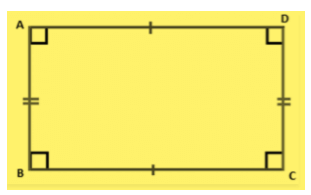
Q10. In the figure, □ABCD is a rectangle. Which of the following is not true?
Solution
Diagonals of a rectangle do not bisect at right angles.
Q11. The sum of interior angles of a regular polygon is 1800o. Find the measure of each interior angle of a regular polygon with half the number of sides of the given polygon.
Solution

Q12. Name the type of quadrilateral associated with each of the following properties:
1. Only one pair of opposite sides is parallel.
2. All sides are equal and all angles are equal.
3. One of the diagonal bisects the other.
Solution
1. Trapezium. Since, in a trapezium one pair of opposite sides is parallel.
2. Square. Since, all sides and all angles are equal in case of square.
3. Kite. Since in a kite one of the diagonal bisects the other.
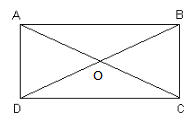
Q13. Given ABCD is a rectangle with diagonals AC and DB. From the given statements, choose the one which is correct.
Solution
In a rectangle, diagonals are equal and they bisect each other.
Therefore,
AC = BD
or, 2OC = 2 OD
or, OC = OD
Q14. In the adjoining figure, ABCD is a quadrilateral.
 (i) How many pairs of adjacent sides are there? Name them.
(ii) How many pairs of opposite sides are there? Name them.
(i) How many pairs of adjacent sides are there? Name them.
(ii) How many pairs of opposite sides are there? Name them.
(i) How many pairs of adjacent sides are there? Name them.
(ii) How many pairs of opposite sides are there? Name them.Solution
(i) There is 4 pair of adjacent sides in quadrilateral ABCD.
(AB, BC), (BC, CD), (CD, DA) and (DA, AB).
(ii) There are only two pairs of opposite sides in given figure.
(AB, DC) and (AD, BC).
Q15. If the sum of the interior angles of a convex polygon is (4 × 180°). What kind of polygon is it?
Solution
We know that the sum of the interior angles of a polygon of n sides is equal to (n - 2) × 180o
Given, that the sum of the interior angles of the polygon is (4 × 180o).
On comparing, we get
n - 2 = 4
n = 4 + 2 = 6
Thus, the polygon is a hexagon.
Q16. The measure of two adjacent angles of a parallelogram is in the ratio 2 : 3. Find the measure of each of the angle of the parallelogram.
Solution
Let the adjacent angles of the parallelogram be 2x and 3x.
We know that sum of adjacent angles of a parallelogram is 180o.
⇒ 2x + 3x = 180o
⇒ 5x = 180o
⇒ x = 36o
Therefore, adjacent angles are 2 × 36o = 72o and 3 × 36o = 108o
We know that the opposite angles of a parallelogram are equal.
Thus, the angles of the parallelogram are 72o, 108o, 72o, 108o.
Q17. In □LMNO, if m ∠L = 100° and m ∠M = 80°, then m ∠N +m ∠O =?
Solution
The sum of angles of a quadrilateral is 360o.
m∠L +m ∠M = 100° + 80° = 180°
∴m ∠N +m ∠O = 180°
Q18. In the given figure, ABCD is a rhombus whose diagonals AC and BD intersect at a point O. If side AB =10 cm and diagonal BD =16 cm, find the length of diagonal AC.

Solution
We know that the diagonals of a rhombus bisect each other at right angles.
∴ BO = BD =
BD =  cm = 8 cm, AB =10 cm and ∠AOB = 900 .
From right triangle OAB, we have
AB2 = AO2 + BO2
⇒AO2 = (AB2 - BO2) = {(10)2 -(8)2} cm2
= (100 -64) cm2 = 36 cm2
⇒ AO =
cm = 8 cm, AB =10 cm and ∠AOB = 900 .
From right triangle OAB, we have
AB2 = AO2 + BO2
⇒AO2 = (AB2 - BO2) = {(10)2 -(8)2} cm2
= (100 -64) cm2 = 36 cm2
⇒ AO =  cm = 6 cm.
∴ AC = 2 × AO = (2×6) cm = 12 cm.
cm = 6 cm.
∴ AC = 2 × AO = (2×6) cm = 12 cm.
BD = cm = 8 cm, AB =10 cm and ∠AOB = 900 .
From right triangle OAB, we have
AB2 = AO2 + BO2
⇒AO2 = (AB2 - BO2) = {(10)2 -(8)2} cm2
= (100 -64) cm2 = 36 cm2
⇒ AO = cm = 6 cm.
∴ AC = 2 × AO = (2×6) cm = 12 cm.
Q19. The length of a rectangle is 8 cm and each of its diagonals measures 10 cm. Find its breadth.
Solution
Let ABCD be the given rectangle in which length AB = 8 cm and diagonal AC = 10 cm.
Since each angle of a rectangle is a right angle,
we have ∠ABC = 900 .
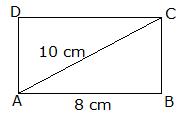 From right angled triangle ABC , we have
AB2 + BC2 = AC2
⇒BC2 = AC2 - AB2 = {(10)2 -(8)2} = (100 - 64) = 36
⇒BC =
From right angled triangle ABC , we have
AB2 + BC2 = AC2
⇒BC2 = AC2 - AB2 = {(10)2 -(8)2} = (100 - 64) = 36
⇒BC =  = 6 cm.
Hence , breadth = 6 cm.
= 6 cm.
Hence , breadth = 6 cm.
From right angled triangle ABC , we have
AB2 + BC2 = AC2
⇒BC2 = AC2 - AB2 = {(10)2 -(8)2} = (100 - 64) = 36
⇒BC = = 6 cm.
Hence , breadth = 6 cm.
Q20. Given figure EFGH is a rectangle with diagonals HF = 4x + 2 and EG = 5x-1. What is the length of OH and OE?
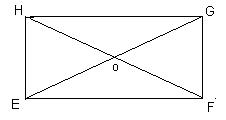
Solution
Since the diagonals are equal in rectangle
So, HF = EG
4x + 2 = 5x-1
2+1 = 5x-4x
3 = x
So, HF = 4×3 + 2 = 14 cm
And EG = 5x3 - 1 = 14 cm
Now, it is also known that the diagonals of a rectangle bisect each other.
Therefore,
OH =  × HF = x14 cm = 7 cm
OE = × EG = x 14 cm = 7 cm
× HF = x14 cm = 7 cm
OE = × EG = x 14 cm = 7 cm
× HF = x14 cm = 7 cm
OE = × EG = x 14 cm = 7 cm
Comments
Post a Comment