Q1. In a square, the diagonals are
Solution
In a square, the diagonals are equal and perpendicular bisectors of
each other.
Q2. A rectangle is called
an equiangular quadrilateral because
Solution
A
rectangle is called an equiangular quadrilateral as all of its angles are
equal.
Q3. Which of the following is not the property of a
parallelogram?
Solution
A
trapezium is not a parallelogram.
Q4. When
the opposite sides are equal and all the angles are right angles, the
quadrilateral is a
Solution
When
the opposite sides are equal and all the angles are right angles, the quadrilateral
is a rectangle.
Q5. The
adjacent angles of a rhombus are ______ angles.
Solution
The
adjacent angles of a rhombus are supplementary angles.
Q6. Which of the following is true?
Solution
Every rectangle is a square.
Q7. A
quadrilateral with adjacent sides not equal but with angles measuring 90˚ is
known as a
Solution
Adjacent
sides of a rectangle are not equal, but its angles measure 90˚.
Q8. For
which of the following, both diagonals bisect each other?
Solution
Diagonals of a square bisect each other.
Q9. For
construction of a rhombus, we need the measures of
Solution
For
construction of a rhombus, we need the measures of two diagonals.
Q10. In a parallelogram, …………….angles
are supplementary.
Solution
In a parallelogram, consecutive angles are supplementary.
Q11. For a
parallelogram, which of the following statements is true?
Solution
Diagonals of a parallelogram bisect each
other.
Q12. In a rhombus, if the measures of one angle is 50˚, then the measure of its adjacent angle is
Solution
Adjacent angles of a rhombus are supplementary, i.e. the sum of two adjacent angles is 130˚.
Q13. A parallelogram can be constructed if
Solution
A parallelogram can be constructed if two
adjacent sides and one angle are given.
Q14. A rhombus with side 7 cm has
Solution
A
rhombus with side 7 cm will have each diagonal less than 14 cm.
Q15. If a
diagonal of a quadrilateral bisects both angles, then it is a
Solution
If a diagonal of a quadrilateral bisects
both angles, then it is a rhombus.
Q16. A quadrilateral with only one pair of opposite sides parallel is
called a
Solution
A quadrilateral with
only one pair of opposite sides parallel is called a trapezium.
Q17. A
rectangle whose adjacent sides are equal is
a
Solution
A
rectangle whose adjacent sides are equal is a square.
Q18. Construct a quadrilateral ABCD in which CA = 5.6 cm, AD = 4.5 cm, BD = 6.5 cm, CD = AD + 0.5 cm and BC = AD - 0.5 cm. Also, write the steps of construction.
Solution
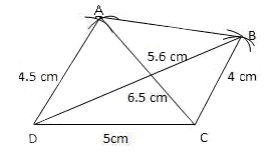 Steps of Construction: (a) Draw DC = 4.5 + 0.5 = 5 cm. (b) With D as centre, draw an arc of radius 6.5 cm and with C as centre, draw an arc of radius 4 cm intersecting the previous arc at point B. Join DB and CB. (c) With D as centre and radius 4.5 cm draw an arc and with C as centre draw an arc of radius 5.6 cm intersecting the previous arc at point A. Join DA and CA. (d) Join AB. ABCD is a required quadrilateral.
Q19. A
quadrilateral with 4 right angles and equal sides is called a
Solution
A square has equal sides and all
angles are 90o.
Q20. In
a parallelogram, …………sides
are congruent.
Solution
In
a parallelogram, opposite sides are congruent.
Q21. Construct
a quadrilateral ABCD where AB = 5.5 cm, CD = 2.5 cm,
∠A = 105°,
∠B = 75°
and ∠C = 110°.
Arrange in the proper order.
i. With A as the centre and radius
5.5cm, draw an arc to intersect AY at B.
ii. Draw ∠XAY= 105°.
iii. With B as the centre and radius
2.5cm, draw an arc to intersect BZ at C.
iv. Draw ∠ABZ = 75°.
Solution
The
correct order is
Draw ∠XAY= 105°.
With
A as the centre and radius 5.5cm, draw an arc to intersect AY at B.
Draw
∠ABZ
= 75°.
With
B as the centre and radius 2.5cm, draw an arc to intersect BZ at C.
Q22. For
which of the following quadrilaterals, are the diagonals equal?
Solution
The diagonals of a rectangle are
equal.
Q23. What is the maximum number of obtuse angles that a quadrilateral can
have?
Solution
The maximum number of obtuse angles that a quadrilateral can have is 3
Q24. A
quadrilateral whose opposite sides and all the angles are equal is a
Solution
The opposite sides and all the angles are equal in a rectangle.
Q25. If the angles of a quadrilateral are each equal
to 80˚, then the fourth angle is
Solution
The
sum of the angles of a quadrilateral is 360˚.
80˚
+ 80˚ + 80˚ + Fourth angle = 360˚
∴
240˚
+ Fourth angle = 360˚
∴
Fourth
angle = 360˚ - 240˚
∴
Fourth
angle = 120˚
Q26. The quadrilateral formed by joining the
mid-points of the sides of a quadrilateral ABCD taken in order is a square
only if
Solution
A square has equal and perpendicular diagonals.
Q27. A quadrilateral is a rectangle if the
Solution
A
quadrilateral is a rectangle if the opposite sides are equal in length and
each angle is 90˚.
Q28. 
Solution

Q29. What is the sum of angles of quadrilaterals?
Solution
The sum of angles of a
quadrilateral is 360o.
Q30. A
quadrilateral whose adjacent sides are not equal is a
Solution
Adjacent sides of a
rectangle are not equal.
Q31. Construct a rectangle ABCD in which side BC = 5 cm and diagonal BD = 6.2 cm.
Solution
 Steps of Construction:
(i) Draw BC = 5 cm.
(ii) Draw CX ⊥ BC.
(iii) With B as centre and radius 6.2 cm draw an arc, cutting CX at D.
(iv) Join BD.
(v) With D as centre and radius 5 cm, draw an arc.
(vi) With B as centre and radius equal to CD draw another arc, cutting the previous arc at A.
(vii) Join AB and AD.
Then, ABCD is the required rectangle.
Steps of Construction:
(i) Draw BC = 5 cm.
(ii) Draw CX ⊥ BC.
(iii) With B as centre and radius 6.2 cm draw an arc, cutting CX at D.
(iv) Join BD.
(v) With D as centre and radius 5 cm, draw an arc.
(vi) With B as centre and radius equal to CD draw another arc, cutting the previous arc at A.
(vii) Join AB and AD.
Then, ABCD is the required rectangle.
Q32. A
quadrilateral whose sides, diagonals and angles are equal is a
Solution
All the sides, diagonals and angles of a square are equal.
Q33. The
minimum number of measurements required to construct a square is
Solution
We
can construct a square if the length of one of its sides or diagonals is
known.
Q34. Construct a quadrilateral ABCD in which AB = 5.5 cm, BC = 3.5 cm,CD = 4 cm, AD = 5 cm, and ∠A = 45°.
Solution
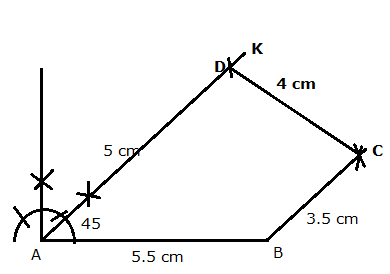 Steps of Construction:
1)Draw AB = 5.5 cm
2)At A, construct ∠BAK = 45°
3)Cut off AD = 5 cm from AK.
4)With B and D as centres and radii 3.5 cm and 4 cm respectively, draw two arcs cutting each other at C.
5)Join BC and DC
ABCD is the required quadrilateral.
Steps of Construction:
1)Draw AB = 5.5 cm
2)At A, construct ∠BAK = 45°
3)Cut off AD = 5 cm from AK.
4)With B and D as centres and radii 3.5 cm and 4 cm respectively, draw two arcs cutting each other at C.
5)Join BC and DC
ABCD is the required quadrilateral.
Q35. Construct a
quadrilateral LMNO where LM = 8cm, MN = 9cm, NO=10 cm and
∠M=115° and ∠N=80°.
Arrange the following in the proper order
i. Join L, M, N, O.
ii. Draw an angle of 105° at M and 80° at N.
iii. Locate L and O.
iv. Draw MN.
Solution
The
correct order is
Draw MN.
Draw an angle of 105° at M and 80° at N.
Locate L and O.
Join L, M, N, O.
Q36. A rectangle ABCD can be constructed if the
length of
Solution
A
rectangle ABCD can be constructed if the lengths of AB and AD are given.
Q37. A special kind of ………… is called a
parallelogram.
Solution
A special kind of polygon is called a
parallelogram.
Q38. Look at the figure and write the steps which are involved in its construction. 
Solution
Steps of Construction: (1) Draw PQ = 4 cm. (2) With P as centre and radius equal to 5 cm, draw an arc. (3) With Q as centre and radius equal to 3.8 cm, draw another arc, cutting the previous arc at R. (4) Join QR and PR. (5) With P as center and radius equal to 3 cm, draw an arc. (6) With Q as center and radius equal to 4.6 cm, draw another arc, cutting the previous arc at S. (7) Join PS, SQ and RS. PQRS is the required quadrilateral.
Q39. A parallelogram is a special kind of ………………. in
which both pairs of opposite sides are parallel.
Solution
A parallelogram is a special kind of
quadrilateral in which both pairs of opposite sides are parallel.
Q40. A
quadrilateral is a ……………..if and only if it is both rhombus and rectangle.
Solution
A
quadrilateral is a square if and only if it is both rhombus and rectangle.
Q41. To construct a parallelogram, given the lengths
of two of its diagonals, we need the measurement of at least
Solution
Given the length of two diagonals of a
parallelogram, we need the measurement of at least one more side to construct
it.
Q42. Draw a parallelogram ABCD in which AB = 5 cm, AD= 4 cm, and the perpendicular distance between AB and CD is 3 cm.
Solution
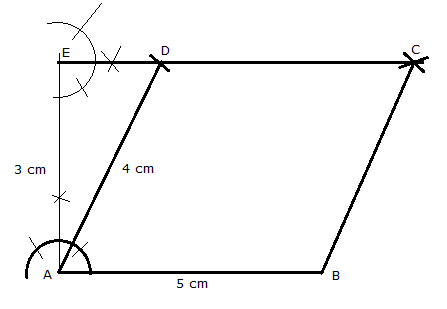 Steps of Construction:
1. Draw AB of length 5 cm
2. Make an angle of 90o at A.
3. Cut AE = 3 cm
4. Make an angle of 90o at E.
5. Cut AD = 4 cm to meet the ray of right angle at point D.
6. With B as center and radius equal to 4 cm, draw an arc.
7. With D as center and radius equal to 5 cm, draw an arc cutting the previous arc at C.
8. Join BC and DC.
ABCD is the required parallelogram.
Steps of Construction:
1. Draw AB of length 5 cm
2. Make an angle of 90o at A.
3. Cut AE = 3 cm
4. Make an angle of 90o at E.
5. Cut AD = 4 cm to meet the ray of right angle at point D.
6. With B as center and radius equal to 4 cm, draw an arc.
7. With D as center and radius equal to 5 cm, draw an arc cutting the previous arc at C.
8. Join BC and DC.
ABCD is the required parallelogram.
Q43. Which of the following is not a
quadrilateral.
Solution
A
triangle has 3 sides, so it is not a
quadrilateral.
Q44. In
a rhombus with diagonal 8 cm, each side will be ____ 4 cm.
Solution
In
a rhombus with diagonal 8 cm, each side will be greater than 4 cm.
Q45. The sum of all ……………of a quadrilateral is
360˚.
Solution
The sum of all angles of a
quadrilateral is 360˚.
Q46. A
quadrilateral with 2 pairs of adjacent congruent sides but not all sides
equal is a
Solution
A
quadrilateral with 2 pairs of adjacent congruent sidesbut
not all sides equal is a kite.
Q47. Only
____ element/s is/are enough to construct a rhombus.
Solution
Only
two elements are enough to construct a rhombus.
Q48. Construct a quadrilateral ABCD when AB = 5.2 cm, AD = 4 cm, BC = 4 cm,  and
and 
and Solution
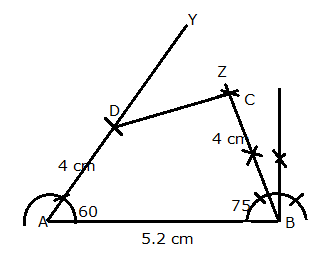 Steps of Construction:
i) Draw AB = 5.2 cm.
ii) Make
Steps of Construction:
i) Draw AB = 5.2 cm.
ii) Make  .
iii) With A as centre and radius 4 cm, draw an arc to cut AY at D.
iv) Make
.
iii) With A as centre and radius 4 cm, draw an arc to cut AY at D.
iv) Make  .
v) With B as centre and radius 4 cm, draw an arc to cut BZ at C.
vi) Join CD.
ABCD is the required quadrilateral.
.
v) With B as centre and radius 4 cm, draw an arc to cut BZ at C.
vi) Join CD.
ABCD is the required quadrilateral.
Q49. Construct a rhombus with side 4.2 cm and one of its angles equal to 65o.
Solution
The adjacent angle = 
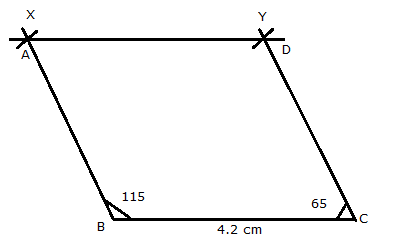 Steps of Construction:
i) Draw BC = 4.2 cm.
ii) Make
Steps of Construction:
i) Draw BC = 4.2 cm.
ii) Make  iii) Set off BA = 4.2 cm along BX and CD = 4.2 cm along CY
iv) Join AD
Thus, ABCD is the required rhombus.
iii) Set off BA = 4.2 cm along BX and CD = 4.2 cm along CY
iv) Join AD
Thus, ABCD is the required rhombus.
Steps of Construction:
i) Draw BC = 4.2 cm.
ii) Make
iii) Set off BA = 4.2 cm along BX and CD = 4.2 cm along CY
iv) Join AD
Thus, ABCD is the required rhombus.
Q50. Construct a rhombus ABCD, whose diagonals are of length 6 cm and 8 cm. Also, write the steps of construction.
Solution
 Steps of construction:
a)Draw AC = 8cm.
b)Draw perpendicular bisector XY of AC meeting AC at O.
c)From O cut off OD =
Steps of construction:
a)Draw AC = 8cm.
b)Draw perpendicular bisector XY of AC meeting AC at O.
c)From O cut off OD =  ×6 cm = 3 cm along OX and OB = ×6 cm =3 cm along OY.
d)Join AB, BC, CD, and DA.
ABCD is the required rhombus.
×6 cm = 3 cm along OX and OB = ×6 cm =3 cm along OY.
d)Join AB, BC, CD, and DA.
ABCD is the required rhombus.
Q51. When
we make a parallelogram with adjacent sides 5 cm and a diagonal of 8 cm, we
get a
Solution
When
we make a parallelogram with adjacent sides 5 cm and a diagonal of 8 cm, we
get a rhombus.
Q52. If EFGH is a parallelogram, then
Solution
If
EFGH is a parallelogram, then EF is parallel to GH.
Q53. Construct a parallelogram with 5.2cm and 4.7cm as lengths of adjacent sides and 7.6cm as the length of the diagonal connecting these given sides. Also, write the steps of construction.
Solution
Let the required ||gm be EFGH with EF = 5.2cm and FG =4.7cm and EG = 7.6cm.
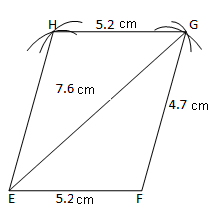 Steps of Construction:
a)Draw EF = 5.2cm.
b)With E is centre and radius 7.6cm, draw an arc.
c)With F as centre and radius 4.7cm, draw another arc which cuts arc of step (b) at point G.
d)Join EG and FG.
e)With G as centre and radius 5.2cm, draw an arc.
f)With E as centre and radius 4.7cm, draw another arc which intersects the arc drawn in step (e) at H.
g)Join HG and HE.
EFGH is the required parallelogram.
Steps of Construction:
a)Draw EF = 5.2cm.
b)With E is centre and radius 7.6cm, draw an arc.
c)With F as centre and radius 4.7cm, draw another arc which cuts arc of step (b) at point G.
d)Join EG and FG.
e)With G as centre and radius 5.2cm, draw an arc.
f)With E as centre and radius 4.7cm, draw another arc which intersects the arc drawn in step (e) at H.
g)Join HG and HE.
EFGH is the required parallelogram.
Steps of Construction:
a)Draw EF = 5.2cm.
b)With E is centre and radius 7.6cm, draw an arc.
c)With F as centre and radius 4.7cm, draw another arc which cuts arc of step (b) at point G.
d)Join EG and FG.
e)With G as centre and radius 5.2cm, draw an arc.
f)With E as centre and radius 4.7cm, draw another arc which intersects the arc drawn in step (e) at H.
g)Join HG and HE.
EFGH is the required parallelogram.
Comments
Post a Comment