Q1.
In a certain store, the profit is 320% of the cost. If the cost increases by 25% keeping the selling price constant, approximately what percentage of the selling price is the profit?
Solution
Let CP = Rs. 100.
Then, Profit = Rs. 320, SP = Rs. 420.
New CP = 125% of Rs. 100 = Rs. 125
New S.P. = Rs. 420.
Profit = Rs. (420 - 125) = Rs. 295
Therefore, required percentage = 
Q2. Of the 15-year-olds at a karate school, 9 have black belts and 15 have brown belts. Among the 16-year-olds, 17 have black belts and 19 have brown belts. Which age group has a higher ratio of black belts to brown belts?
Solution
The ratio of black belts to brown belts:
Among 15-year-olds - 9 : 15
Among 16-year-olds - 17 : 19
We have to find which is higher:  We can compare the ratios more easily by expressing them in percentage.
To convert into %, multiply the ratio by 100.
Thus,
We can compare the ratios more easily by expressing them in percentage.
To convert into %, multiply the ratio by 100.
Thus,
 And
And
 Comparing, we get
60% < 89.47%
Thus, the 16-year-olds have a higher ratio of black belts to brown belts.
Comparing, we get
60% < 89.47%
Thus, the 16-year-olds have a higher ratio of black belts to brown belts.
We can compare the ratios more easily by expressing them in percentage.
To convert into %, multiply the ratio by 100.
Thus,
And
Comparing, we get
60% < 89.47%
Thus, the 16-year-olds have a higher ratio of black belts to brown belts.
Q3. In a certain school, 20% of students are below 8 years of age. The number of students above 8 years of age is  of the number of students of 8 years of age which is 48. What is the total number of students in the school?
of the number of students of 8 years of age which is 48. What is the total number of students in the school?Solution
Let the number of students in the school be x.
Then,
Number of students above and equal to 8 years of age
= (100 - 20) % of x
= 80% of x.
 Total number of students in the school is 100.
Total number of students in the school is 100.
Q4. Suppose Anil bought something that was priced at Rs 6.95, and the total bill was Rs 7.61. What is the sales tax rate in this city?
Solution
The sales tax is a certain percentage of the price, so first figure out what the actual tax was.
The tax was:
7.61 - 6.95 = 0.66
Then
Rate of sale tax =  Hence, the sales tax rate is 9.5%.
Hence, the sales tax rate is 9.5%.
Q5. A motorcycle is bought at Rs.160000. Its value depreciates at the rate of 10% per annum. Find its value after
i) 1 year
ii) 2 years
Solution
i) Value of motorcycle after 1 year
 Therefore, value after 1 year = Rs.144000
ii) Value of motorcycle after 2 years
Therefore, value after 1 year = Rs.144000
ii) Value of motorcycle after 2 years
 Therefore, value after 2 years= Rs.129600
Therefore, value after 1 year = Rs.144000
ii) Value of motorcycle after 2 years
Therefore, value after 2 years= Rs.129600
Q6. Marked price of a table is Rs 300. Seller sells it at a discount of 20% and still earns a
profit of 20%. What is the cost price?
Solution
Selling
Price =


 Hence, cost price = Rs 200
Hence, cost price = Rs 200
Q7. If 40% of a number is equal to two-third of another number, what is the ratio of first number to the second number?
Solution
Let A and B be the two numbers such that,
40% of A =  Then,
Then,

Then,
Q8. X and Y can paint the house in 18 days, Y and Z in 24 days and X and Z in 36 days. In how many days Y will finish it separately?
Solution
X and Y can paint the house in 18 days  (X + Y)'s 1 day's work =
  Y and Z can paint the house in 24 days (Y + Z)'s 1 day's work =
  X and Z can paint the house in 36 days (X + Z)'s 1 day's work =
  Adding, we get
2(X + Y + Z)'s 1 day's work =
Adding, we get
2(X + Y + Z)'s 1 day's work =  Thus, (X + Y + Z)'s 1 day's work =
  Y's 1 day's work = [(X + Y + Z)'s 1 day's work] - [(X + Z)'s 1 day's work]
 Hence, Y alone can paint the house in
  days.
days.
(X + Y)'s 1 day's work =
Y and Z can paint the house in 24 days (Y + Z)'s 1 day's work =
X and Z can paint the house in 36 days (X + Z)'s 1 day's work =
Adding, we get
2(X + Y + Z)'s 1 day's work =
Thus, (X + Y + Z)'s 1 day's work =
Y's 1 day's work = [(X + Y + Z)'s 1 day's work] - [(X + Z)'s 1 day's work]
Hence, Y alone can paint the house in days.
Q9. P can make a Diamond set in 40 days and Q in 45 days. They work together for 10 days and then Q goes away. In how many days will P finish the remaining work?
Solution
P can make a set in 40 days  P's 1 day's work =
  Q can make a set in 45 days Q's 1 day's work =
  So, (P + Q)'s 1 day's work =
  Henec, (P + Q)'s 10 day's work =
  Remaining work =
  Now, remaining work is done by P and P can complete the work in 40 days.
Thus,
Now, remaining work is done by P and P can complete the work in 40 days.
Thus,  of the work is done by P in
P's 1 day's work =
Q can make a set in 45 days Q's 1 day's work =
So, (P + Q)'s 1 day's work =
Henec, (P + Q)'s 10 day's work =
Remaining work =
Now, remaining work is done by P and P can complete the work in 40 days.
Thus, of the work is done by P in
Q10. If the price of one pair of jeans is Rs 2100 and is reduced by one-third, how much sales tax must be paid on the jeans that has 3% sales tax?
Solution
Sale price = Original price -  Original price
= Rs (2100 -
Original price
= Rs (2100 -  2100)
= Rs (2100 - 700)
= Rs 1400
Sales tax = price x rate%
=
2100)
= Rs (2100 - 700)
= Rs 1400
Sales tax = price x rate%
=  = Rs 42
Rs 42 had to be paid as sales tax.
= Rs 42
Rs 42 had to be paid as sales tax.
Original price
= Rs (2100 - 2100)
= Rs (2100 - 700)
= Rs 1400
Sales tax = price x rate%
=
= Rs 42
Rs 42 had to be paid as sales tax.
Q11. The value of a machine depreciates every year by 10%. If the present value of the machine is Rs 99000, what was its value last year?
Solution
Let the value of the machine last year be Rs x.
Then, its present value = 90% of Rs x.

 Hence, the value of the machine last year was = Rs 110000.
Hence, the value of the machine last year was = Rs 110000.
Q12. Pipe A can fill a tank in 12 hours and pipe B in 15 hours. If both the pipes are opened simultaneously, and the pipe A is closed after 3 hours, then how much more time will it take to fill the remaining tank by pipe B?
Solution
Pipe A can fill a tank in 12 hours  Part of a tank filled by pipe A in 1 hour =
  Pipe B can fill a tank in 15 hours Part of a tank filled by pipe B in 1 hour =
  Part of a tank filled by A and B in 1 hour =
  Thus, in 3 hours, part of a tank filled by A and B =
  Remaining part of the tank =
  Now, pipe B can fill the tank in 15 hours
 part of the tank can be filled by pipe B in
  =8.25 hours
Part of a tank filled by pipe A in 1 hour =
Pipe B can fill a tank in 15 hours Part of a tank filled by pipe B in 1 hour =
Part of a tank filled by A and B in 1 hour =
Thus, in 3 hours, part of a tank filled by A and B =
Remaining part of the tank =
Now, pipe B can fill the tank in 15 hours
part of the tank can be filled by pipe B in =8.25 hours
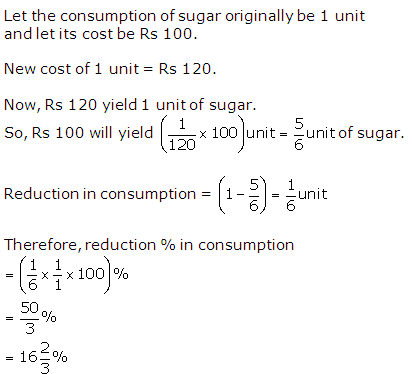
Q13. The price of sugar goes up by 20%. By how much percent must a housewife reduce her consumption of sugar so that the expenditure on sugar remains the same?
Solution
Q14. Harish sold a bicycle at 8% gain. Had it been sold for Rs 75 more, the gain would have been 14%. Find the cost price of the bicycle.
Solution
Let the cost price of the bicycle be Rs x.
SP of the bicycle at 8% gain = 
 SP of the bicycle at 14% gain

 Hence, cost price of the bicycle = Rs 1250
SP of the bicycle at 14% gain
Hence, cost price of the bicycle = Rs 1250
Q15. Clothing store A sells T-shirts in only three colours: red, blue and green. The colours are in the ratio of 3 to 4 to 5. If the store has 20 blue T-shirts, how many T-shirts does it have altogether?
Solution
Let x be the number of red T-shirts
And, y be the number of green T-shirts
Given: Red : Blue : Green = 3 : 4 : 5, therefore

 Thus, Total number of T-shirts = 15 + 25 + 20 = 60
Thus, Total number of T-shirts = 15 + 25 + 20 = 60
Q16. A music store has reduced the price of all stock by 25%. A customer who purchased a CD from this store paid Rs 240. What is the usual price of this CD, and what is the cash discount?
Solution
selling price =Rs 240,
discount = 25% of the marked price
but: (marked price) = (selling price) + discount
So the selling price must be: (100-25 = 75)% of the marked price, i.e.:
selling price =  × (marked price)
So:
marked price =
× (marked price)
So:
marked price =  × (selling price)
=
× (selling price)
=  ×240
= 320
The CD usually costs Rs320, and the cash discount is: (320-240) = Rs80
×240
= 320
The CD usually costs Rs320, and the cash discount is: (320-240) = Rs80
× (marked price)
So:
marked price = × (selling price)
= ×240
= 320
The CD usually costs Rs320, and the cash discount is: (320-240) = Rs80
Comments
Post a Comment